Full arch tooth replacement
Replacing a whole arch is a decision, not a purchase.
Somebody has quoted you a very large number and used words you had to look up afterwards. This site explains what the options actually are, what they honestly cost in 2026, how long treatment really takes, and the ten questions that separate a serious clinic from a confident one.
Start here
What “full arch” means, in plain English
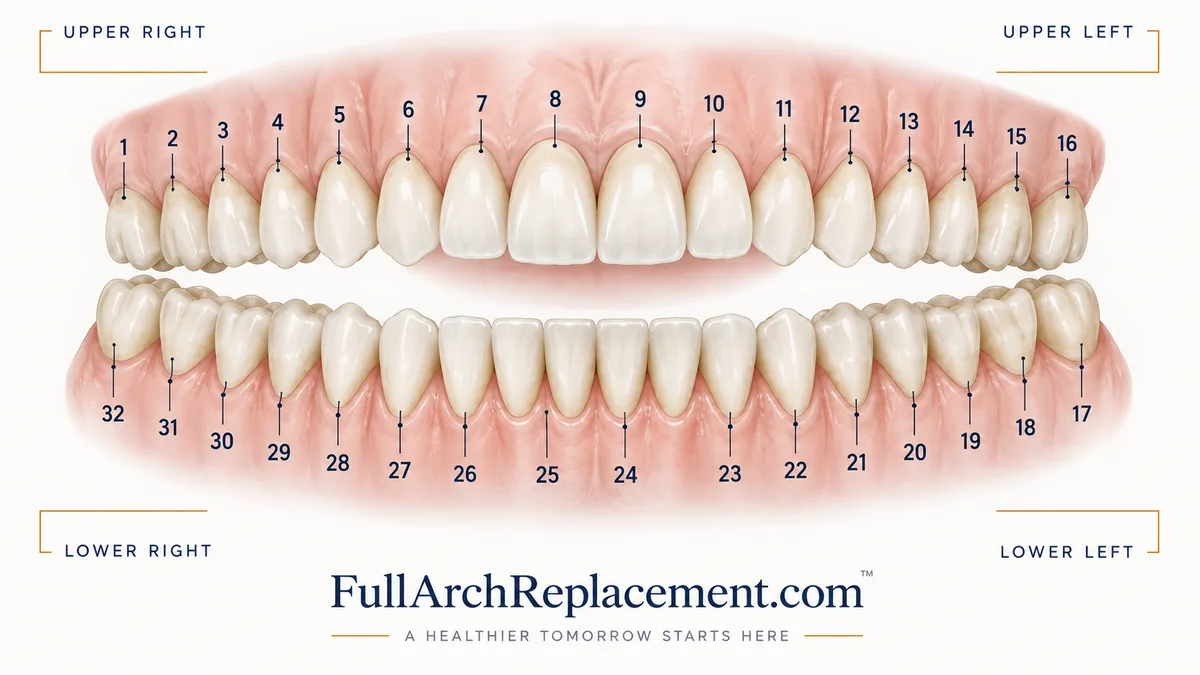
An arch is one complete row of teeth. Your upper arch runs from tooth #1 to #16. Your lower arch runs from #17 to #32. A full arch replacement swaps every tooth in one of those rows for a single prosthetic bridge, anchored on titanium implants placed in the jawbone.
The bridge is screwed down. You do not take it out, you do not soak it overnight, and it does not rock when you bite into something. That is the whole point of it, and it is what separates this from a denture.
The confusing part is the vocabulary. All-on-4 is a technique — a fixed bridge on four implants, with the back two tilted to catch better bone. All-on-6 and All-on-X are the same idea with more anchors. Full mouth means both arches, which is two of everything and roughly twice the treatment cost.
The number that matters is per arch. Clinics quote per arch, and consumers hear it as per mouth. If you need upper and lower, double the treatment line before you compare anything.
Your options
Five ways to replace a full arch
They differ in what they cost, how they feel, whether they come out, and what they do about ongoing bone loss. Price tracks all of that fairly closely.
What each solution costs in the United States
Per arch (one full upper or one full lower). Both arches roughly doubles the treatment line.
Typical 2026 US market planning ranges, per arch, compiled from published cash-pay cost guides and clinic pricing pages. These are ranges, not quotes. Headline prices frequently exclude extractions, CBCT imaging, bone grafting, IV sedation and the final prosthesis. Ask for one itemised, all-in number from consult to final teeth before you compare anything.
| Solution | Implants per arch | Removable? | Bite strength | Stops bone loss? | US range / arch |
|---|---|---|---|---|---|
| Conventional denture | 0 | Yes, fully | Weakest | No | $300 – $3,000 |
| Snap-in overdenture | 2 – 4 | Yes, by you | Good | Partly, at the anchor sites | $7,000 – $13,500 |
| All-on-4 fixed arch | 4 (2 tilted) | No, screw-retained | Strong | Yes, where implants sit | $14,000 – $26,000 |
| All-on-6 / All-on-X | 6 – 8 | No, screw-retained | Strongest | Yes, over a wider span | $17,000 – $28,000 |
| Zygomatic anchorage | 2 – 4 zygomatic + conventional | No | Strong | Bypasses lost upper jaw bone | $22,000 – $36,000+ |
A conventional denture is the only option here that does nothing to slow jawbone resorption, which is why long-term denture wearers often see facial collapse. Implants transmit bite load into the bone and preserve it locally, around the implant sites.
How it holds together
Four components, four ways a quote can hide money
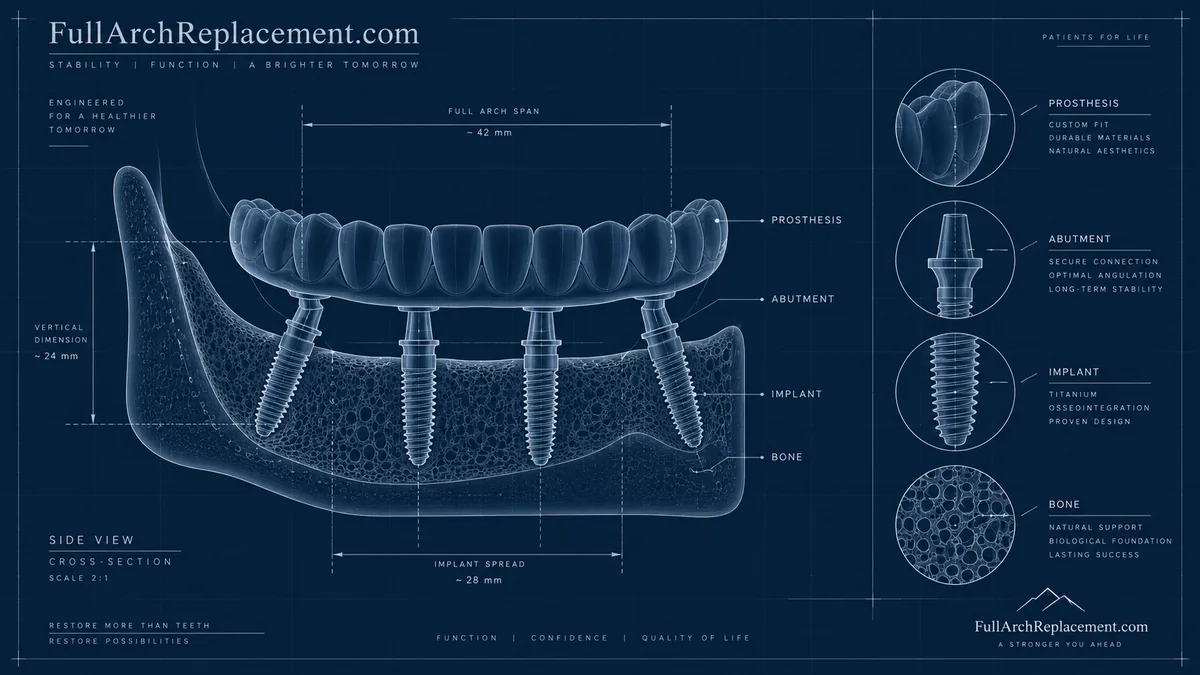
Understanding the stack is how you read a quote properly. A price that covers “implants” may not cover abutments. A price that covers the surgery may not cover the final bridge. Ask specifically about each layer.
- Bone. Volume and density decide everything. Insufficient bone means grafting, a sinus lift or zygomatic implants — each adds cost and months.
- Implant. The titanium post. Brand and platform matter for servicing the work later. Get them in writing.
- Abutment. The connector. Often quoted separately, and often left out of a headline price.
- Prosthesis. The visible arch. Acrylic hybrid and zirconia are different products at different prices — confirm which one you are being quoted.
The money
What it costs, and what the sticker price leaves out
Full-arch work is one of the largest out-of-pocket health purchases most people ever make, and it is priced with almost no transparency. Here is the honest picture.
The same arch, five countries
All-on-4 style fixed full arch, acrylic hybrid tier, price per arch.
Market estimate ranges as of 2026, compiled from published clinic pricing and public cost guides. Not quotes. Costa Rica is marked directional because corroborating published pricing is thinner than for the other four. Compare the same material tier across countries or the comparison is meaningless: an acrylic hybrid abroad against a zirconia bridge at home is not a like-for-like number.
All-in trip math, not sticker price
Travel overhead is roughly fixed. The more work you need, the smaller a share of the bill it becomes.
- Treatment
- Flights (2 trips)
- Lodging & food
- Return-visit buffer
Illustrative planning model using the midpoints of the ranges above, one traveller, two trips, roughly three weeks of lodging in total, plus a $1,000 buffer for an unplanned return visit. It is a model, not a quote. Add a companion, a longer stay, sedation, grafting or a zirconia upgrade and the Colombia column rises. It is also worth pricing your own market honestly first: some US practices discount hard for cash and some dental school clinics run 40 to 60 percent under private fees.
Compare the same material
An acrylic hybrid abroad against zirconia at home is not a comparison. Pick the material first, then price it in every location.
Demand the all-in number
From first consult to final prosthesis, including extractions, imaging, sedation and every follow-up. Anything else is a deposit, not a price.
Budget the second trip
Most full-arch plans need two or three visits. If your budget only covers one, the plan is already broken.
If you are paying a clinic abroad, compare the total landed cost including the exchange rate spread before wiring anything. Bank wires and card payments frequently carry a 3–5 percent markup baked into the rate, which on a $20,000 case is real money. Wise publishes the mid-market rate up front, which makes it easy to see what a spread is actually costing you. That is an affiliate link and we may earn a commission at no cost to you.
The process
What the next twelve months look like
The marketing says “teeth in a day.” That is true of the temporary arch. The finished result takes considerably longer, and the healing phase is the part that determines whether the work lasts.
A full-arch case is a year, not a weekend
Typical phased-loading timeline. Some strong-bone cases move faster; grafted cases move slower.
Generalised timeline for planning purposes only. Your surgeon sets the real schedule from your 3D scan and bone quality. The single most common mistake in dental tourism is booking one short trip for a case that clinically needs two or three. Ask, in writing, how many visits your plan requires and what happens if healing runs long.
Six phases, in order
Records and diagnosis
CBCT 3D scan, intraoral scan, photographs, medical history. This is where candidacy and cost are genuinely determined.
Surgery and immediate provisional
Remaining teeth extracted if needed, implants placed, a temporary arch fitted the same day in most cases.
Osseointegration
Three to six months while bone fuses to the implant surface. Soft diet at first. This phase cannot be shortened by wanting it shorter.
Try-in and refinement
Bite, shade, lip support and speech are assessed and adjusted before anything is made permanent.
Final prosthesis
The definitive bridge is milled or processed, seated and torqued to specification. This is the set you keep.
Maintenance, indefinitely
Professional cleaning around the implants, screw checks and occlusal adjustment. Skipping this is how good work fails early.
Materials
Acrylic or zirconia decides a third of your bill
This single choice moves the price more than the country you fly to. Make it deliberately, and make it before you start collecting quotes.
| Bridge material | Feel & look | Durability | Repairability | Relative cost |
|---|---|---|---|---|
| Acrylic hybrid on titanium bar | Lighter, slight cushioning on the bite | Teeth wear; chips are common over years | Easy — repaired chairside | Entry tier |
| Monolithic zirconia | Hard, glassy, highly stain resistant | Very high; can transmit more force | Hard — fracture usually means a remake | Premium, often +40 to +80% |
| Layered zirconia / porcelain | Most lifelike translucency | Beautiful, but the veneering layer can chip | Moderate | Premium |
| PEEK / composite hybrids | Light, shock absorbing | Newer category; long-term data is thinner | Moderate | Varies widely |
Treatment abroad
Why Colombia comes up so often
Four to six hours from most US hubs, same or near-same time zone, a large implant-focused private dental market in Bogotá, Medellín and Cali, and prices that put both arches inside the cost of one arch at home.
Colombia was ranked first in the Western Hemisphere and 22nd globally in the World Health Organization’s 2000 World Health Report. That is a historical ranking, not a current one, and any site presenting it as today’s scorecard is being loose with you. It is useful context for a health system that has been building international capacity for decades, nothing more.
What you should actually verify is current and specific, and all three checks are public:
- REPS — confirm the facility is a registered health service provider and that dentistry is a registered service at that address.
- ReTHUS — confirm the individual dentist by full legal name in the national health professional registry.
- INVIMA — confirm the implant system carries an active device registration.
On JCI accreditation: it applies to hospitals and health systems. A standalone dental clinic will not hold it. If one claims to, that tells you something.

Keep reading
The rest of the network
Same team, same standards, different questions.
Due diligence
Ten questions to send before you pay anything
Copy these into an email or a WhatsApp message and send them to every clinic on your shortlist, at home and abroad. How a clinic answers is more informative than what it charges. Vagueness on any of these is your answer.
- Send me the itemised, all-in price from consult to final prosthesis, in writing.
- Which of these are excluded: extractions, CBCT scan, bone graft, sinus lift, sedation, temporary arch, final arch, follow-up visits?
- What implant system and brand will you use, and will I get the platform, diameter and reference numbers in writing at handover?
- How many visits does my specific case need, and how long is each one?
- Is the price quoted for an acrylic hybrid or a zirconia bridge?
- Who is the surgeon placing the implants, and what is their full legal name for registry verification?
- How many full-arch cases does that surgeon complete per year?
- What is your written warranty, how long does it run, what does it cover, and does it require me to return?
- What is the protocol if a screw loosens, an implant fails or the prosthesis fractures after I fly home?
- Can you provide the CBCT scan and treatment plan as files I can take to a second opinion?

Six red flags
A firm price before a 3D scan
Nobody can cost a full-arch case from a photo or a panoramic x-ray alone. A number quoted that early is marketing, not a plan.
“JCI accredited” on a standalone dental clinic
JCI accredits hospitals and health systems, not private dental practices. Misusing it signals sloppiness at best.
Refusing to name the implant brand
Undocumented hardware is the single biggest long-term risk in dental tourism. If a dentist at home cannot identify your implant, servicing it becomes far harder.
One short trip for a full case
Phased loading takes months. A clinic compressing that into five days is either doing something unusual or not telling you about the second trip.
Pressure, countdown discounts, deposits by wire
Legitimate clinics will let you take the plan to a second opinion. Urgency is a sales tactic, not a clinical finding.
Before-and-after photos with no provenance
Ask whether the pictured case was treated by the same surgeon, at the same clinic, with the same material tier.
Questions
The things people actually ask
What actually is a full arch replacement?
It replaces every tooth in one jaw — a full upper or a full lower — with a single prosthetic arch anchored on dental implants rather than resting on the gum. The implants are titanium posts placed into the jawbone. The arch of teeth is screwed onto them, so it does not come out at night. “All-on-4” is one specific technique for doing this using four implants, two of them angled to make use of available bone. All-on-6 and All-on-X are the same idea with more anchors.
Am I a candidate if I have already lost a lot of bone?
Often yes, and that is much of the point of the angled-implant approach: tilting the rear implants lets a surgeon reach denser bone and sometimes avoids a graft. Where bone loss is severe, options include bone grafting, a sinus lift, or zygomatic implants anchored in the cheekbone. All of those add cost and time. Only a 3D CBCT scan can answer this. Be sceptical of any clinic willing to promise candidacy from a photograph.
Will I leave surgery with teeth?
Usually, yes — a temporary, or provisional, arch. That is what “teeth in a day” refers to. It is not your final prosthesis. The permanent one is made after the implants have integrated and your gum tissue has settled, typically several months later. Any clinic implying the teeth you walk out with are the finished product is glossing over the most important part of the process.
All-on-4 or All-on-6 — which should I get?
Bone decides, not budget. More implants spread bite force across more anchor points and give you redundancy if one implant fails, but they need enough bone volume in the right places. Someone with dense bone and heavy bite forces may benefit from six. Someone with a resorbed upper jaw may be a four-implant tilted case by necessity. Ask your surgeon to explain the recommendation in terms of your scan, not in terms of a package tier.
Acrylic or zirconia for the final bridge?
Acrylic hybrids cost less, are easier and cheaper to repair chairside, and absorb some shock, but the teeth wear and can fracture over time. Monolithic zirconia is far harder, more stain resistant and more expensive, but a fracture usually means remaking the whole bridge. Neither is universally correct. Decide the material first, then compare prices across clinics for that same material — otherwise you are comparing two different products.
How much does a full arch cost?
In the United States, roughly $14,000 to $36,000 per arch for a fixed implant bridge, with complex cases running higher. Abroad, the same acrylic-hybrid tier commonly lands between about $5,000 and $17,000 per arch depending on country and clinic. These are 2026 market planning ranges, not quotes. What matters far more than the headline is what the number includes: extractions, CBCT, sedation, grafting, the temporary arch and the final prosthesis are all line items that get quietly excluded.
Is going abroad for this actually sensible?
It can be, and for two full arches the savings are large enough to be genuinely life-changing. The honest counterweight is that a full-arch case involves months of healing, adjustments and follow-up, and managing that from another country is harder. The risk is logistical more than clinical. Plan for at least two trips, get the implant brand and reference numbers in writing so a dentist at home can service the work, and line up a local dentist for emergencies before you fly.
How do I verify a Colombian clinic and dentist?
Three public registries. Check the facility in REPS, Colombia’s official register of health service providers. Check the individual dentist by full legal name in ReTHUS, the national registry of health professionals. Check that the implant system itself holds an active INVIMA registration. Do all three yourself before you pay a deposit. Note that JCI accreditation is a hospital-level credential — a standalone dental clinic will not carry it, and claiming otherwise is a red flag.
What happens if something goes wrong after I fly home?
This is the question most people skip. A warranty from a foreign clinic almost never obliges a dentist in your own country to fix the work for free; it typically requires you to return. Budget for that possibility rather than assuming it away. The worst case is an undocumented implant system: if nobody knows the brand, platform and size, a dentist at home may have to remove it and rebuild the site from scratch. Insist on written device documentation at handover.
Does insurance cover any of this?
US dental plans typically carry annual maximums in the low thousands, which barely dents a full-arch case, and many classify implants as a major or excluded service. Some medical plans contribute where tooth loss follows trauma or cancer treatment. Nothing here is insurance advice — read your own plan documents and get any pre-authorisation in writing. Treatment abroad is usually paid out of pocket.
Get oriented
Tell us your case, we will tell you what to ask
We are not a clinic and we do not treat patients. What we do is help you understand your options, sanity-check a quote you have already been given, and point you at clinics that will answer the ten questions above.
No cost, no obligation, and we will tell you plainly if we think travelling is the wrong call for your situation.
Faster on WhatsApp. Most people would rather send a voice note than fill in a form. Message +1 614 607 1230.
One last thing
Take the plan to a second opinion
Whatever you have been quoted, wherever it came from: get the CBCT scan and the written treatment plan as files, and show them to one more clinician before you commit. It costs a consultation fee and it is the cheapest insurance in this entire process.